Plymouth Rock Barred: The American Breed with an Unmistakable Plumage
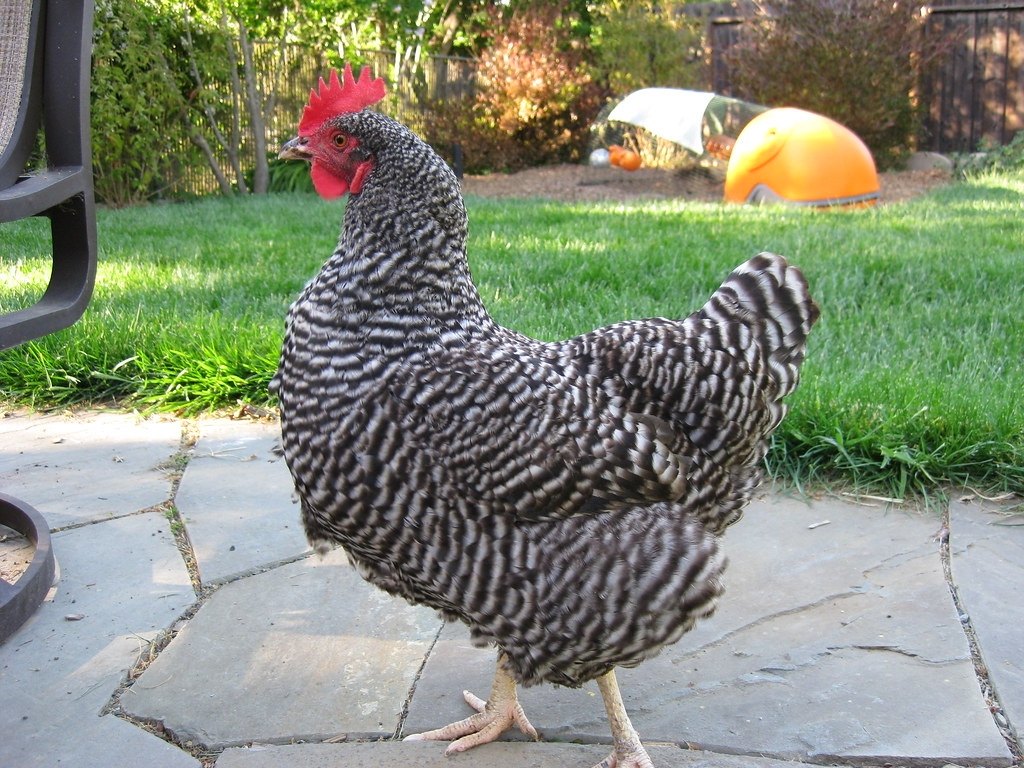
The Barred Plumage: A Unique Visual Identity
The Plymouth Rock Barred has one of the most recognizable plumages in the poultry world: alternating horizontal bands of white and black evenly distributed across the entire body, from head to tail. Each individual feather has these two distinct color bands, creating a visual effect of sharp stripes that appear almost like a printed fabric from a distance. It's not a diffuse or mixed-color plumage: the white is pure white and the black is pure black, with a very marked contrast that makes the Plymouth Rock unmistakable even when viewed from afar in the coop.
This barred pattern—called "barred" or "cuckoo" in English—is not exclusive to the Plymouth Rock, but no other large, productive breed exhibits it as clearly and consistently. The barred or "Barred Rock" variety is the most well-known and widespread within the breed, although Plymouth Rocks also come in white, buff, silver, blue, partridge, and black. In Spain, the Barred Rock is the one most associated with the Plymouth Rock name and the most commonly raised in both production and ornamental poultry farming.
American History: From National Breed to Global Classic
The Plymouth Rock was developed in the United States in the mid-19th century, with the first specimens exhibited at a fair in Boston in 1849. For several decades, it was the most popular breed in North America for combining acceptable egg production with good body size for meat, resistance to the variable climate of North American Northeast, and a calm temperament. At its peak of popularity—late 19th and early 20th centuries—it was the quintessential dual-purpose breed in thousands of American farms.
It arrived in Europe at the end of the 19th century and adapted very well to the climate of northern Europe, where its cold and rain resistance made it a popular choice. In Spain, the Plymouth Rock Barred has a significant presence in purebred poultry farming and in domestic chicken coops in northern regions, where its climate resistance traits are especially valued. It has contributed its genetics to several modern commercial hybrids, being one of the base breeds of the Isa Brown alongside the Rhode Island Red.
Production and Longevity
The Plymouth Rock produces between 200 and 230 brown eggs per year in its first year. This figure is appropriate for a dual-purpose breed but not exceptional when compared to commercial hybrids. However, the true strength of the Plymouth Rock lies not in the number of eggs in the first year but in its consistency and productive longevity: a well-cared-for Plymouth Rock can maintain an acceptable production—around 60-70% of its first-year output—until its third or fourth laying year, something no commercial hybrid can match, as their production drops sharply after the first or second cycle.
For the poultry farmer who doesn't want to frequently renew the flock and appreciates the continuity of the same birds over years, this longevity has real economic and sentimental value. The eggs are medium-large, with consistent shells and uniform brown color. Winter production is better than many similar purebred breeds: although it decreases with shorter days, it doesn't stop completely like some more Mediterranean-sensitive breeds. Combined with supplemental artificial lighting, it maintains a fairly stable production throughout the year.
Temperament and Management in the Family Coop
The temperament of the Plymouth Rock Barred is one of its greatest attractions for the home chicken keeper. It is one of the calmest and easiest-to-handle breeds in all poultry farming, comparable to the Sussex and considerably more docile than the Rhode Island Red or the Leghorn. It accepts human handling well, doesn't flee when someone approaches, and adapts quickly to new people if accustomed to them from a young age. It doesn't initiate aggressive behaviors with other hens in the group nor displays the marked dominance characteristic of more temperamental breeds.
This docility makes it an excellent choice for families with children who want to interact directly with the hens. It also facilitates veterinary management, health inspections, egg collection from the nest with the hen inside, and any intervention requiring handling the animal. In mixed flocks with multiple breeds, the Plymouth Rock tends to occupy a mid-to-high position in the group hierarchy without being aggressive toward the more calm breeds, making it a stabilizing element in the social order of the coop.
Cold Resistance and Geographical Recommendation
The Plymouth Rock Barred is one of the most cold- and rain-resistant breeds among medium-to-large laying hens. Its robust build, dense plumage, and simple, moderately sized crest—more resistant to frost than the large crest of the Leghorn—makes it especially suitable for the climatic conditions of northern Spain. In Galicia, Asturias, Cantabria, the Basque Country, Navarre, and interior areas with harsh winters, the Plymouth Rock produces more consistently than Mediterranean-origin breeds not adapted to cold and persistent humidity.
A factor to consider is that it matures slightly slower than hybrids: it starts laying between 20 and 24 weeks, 2-4 weeks later than an Isa Brown or Lohmann Brown. For someone buying day-old chicks expecting eggs in a few months, this difference may be frustrating. However, once in production, the Plymouth Rock compensates for this initial wait with years of consistent, stable production that hybrids cannot match. It's the breed for those thinking in the long term, not for those seeking immediate results.
Tips for Raising Plymouth Rock Barred
- It's the first breed to consider for northern Spain: its cold resistance, rain tolerance, and short-day adaptability make it the most suitable option for the Cantabrian and Atlantic climates.
- Plan for at least 3 years of production before renewing the flock: its productive longevity is its main advantage over commercial hybrids.
- Introduce artificial lighting in winter to reach 14-15 hours of light: although more resistant than many breeds, light remains the primary regulator of laying.
- Combine it well with Sussex, Orpington, or New Hampshire in mixed flocks: its calm temperament is compatible with similar-tempered breeds without conflicts.
- Take advantage of the barred plumage's visual texture in social media photos or direct sales materials: it's one of the breeds that most attracts visual attention and can be a marketing argument.
- Don't install fences shorter than 1.5 m if the coop isn't roofed: although not as good a flyer as the Leghorn, it can jump low fences when motivated.