Orpington: the most docile chicken that exists and why it's perfect as a productive pet
English origin and the goal of the breed
The Orpington was created in the English town of Orpington in Kent by William Cook, who first exhibited his creation in 1886. Cook's objective was pragmatic: he wanted a dual-purpose breed that could produce a reliable supply of eggs while also providing a good-quality table bird — a combination that was increasingly valued in Victorian Britain as poultry farming became more formalised. He achieved this by crossing Minorca, Langshan, and Plymouth Rock birds, selecting for a large, calm, abundantly feathered bird that was entirely different in temperament and appearance from the active Mediterranean-type layers that dominated at the time.
The buff (golden) variety was the first Orpington Cook produced and it quickly became iconic, winning widespread popularity at poultry shows and among backyard keepers alike. Additional colour varieties followed — black, white, and blue — and the breed expanded internationally during the late 19th and early 20th centuries, becoming particularly popular in Australia, New Zealand, and the United States. Today the Orpington is kept primarily for its extraordinary temperament and ornamental qualities rather than as a commercial producer, though it remains a genuinely useful layer for domestic keepers who value calm, manageable birds above all else.
Appearance: the original fluffy chicken
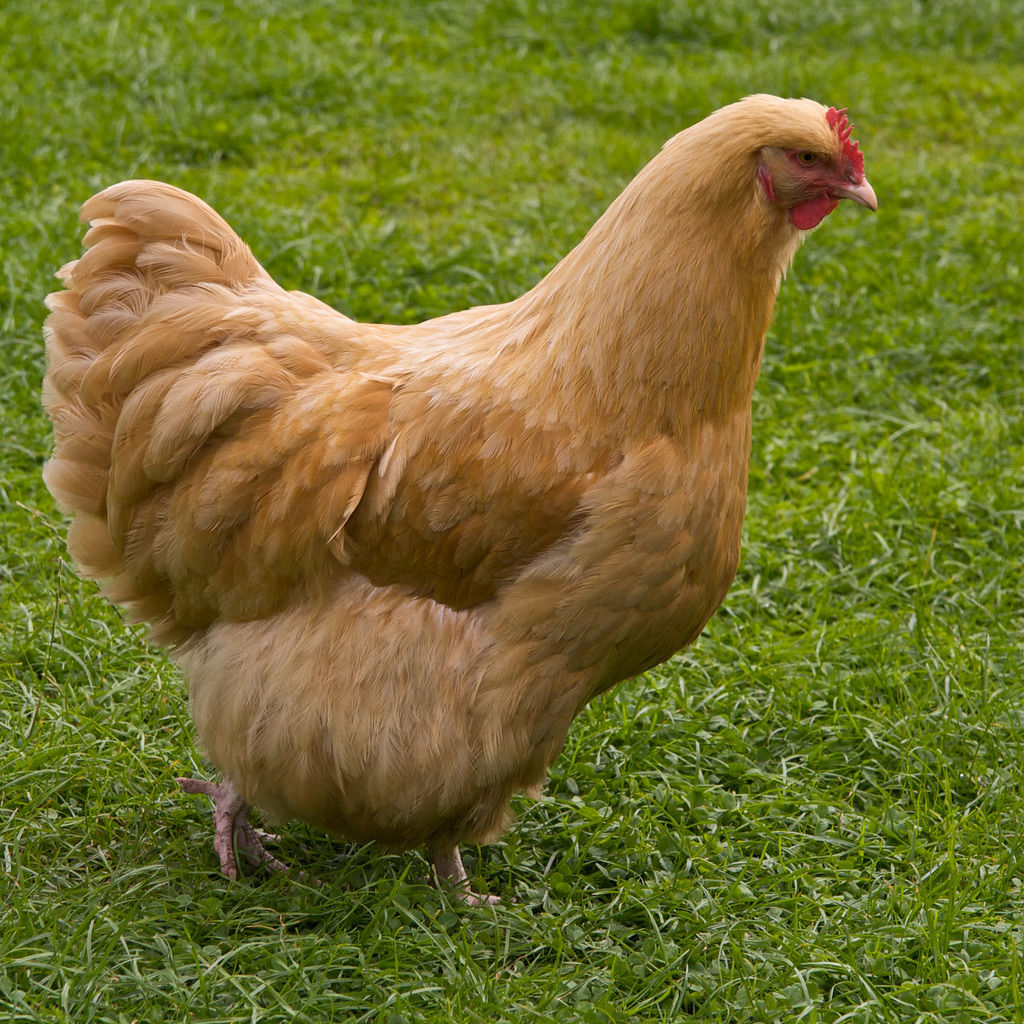
The Orpington's most immediately striking characteristic is its size and the extraordinary abundance of its plumage. Hens weigh 3–4 kg and roosters can reach 4.5 kg or more, but the dense, fluffy feathering makes the birds look even larger than they are. The feathers are full, rounded, and close-fitting around the body, creating a ball-like silhouette that is unlike almost any other breed. The comb is small and single, which combined with the thick plumage gives the breed reasonable cold tolerance — the feathers provide effective insulation, and the small comb minimises frost risk.
The buff variety — warm golden all over — remains the most popular and is what most people visualise when they hear the name Orpington. The black variety has an attractively glossy plumage with greenish iridescence in full sunlight. The white is elegant and immediately eye-catching, though it shows dirt more readily than the buff. The blue is a soft grey-blue that is visually distinctive and increasingly sought after. All varieties share the same characteristic body type and temperament — the colour differences are purely aesthetic rather than related to any difference in behaviour or production.
The Orpington's unmatched temperament
The Orpington is widely considered the most docile of all common chicken breeds, and this assessment is consistently borne out by the experience of anyone who has kept them. Where most breeds take flight or at least step back when approached, an Orpington typically stands its ground and allows itself to be picked up without fuss. Experienced keepers describe mature Orpington hens that will actively walk toward people, sit in laps, and tolerate being handled in ways that would cause most breeds significant stress. This characteristic is not limited to hand-raised individuals — it appears to be genuinely ingrained in the breed's temperament through generations of selection for calm, manageable birds.
This docility makes the Orpington an ideal choice for families with young children who want to interact directly with their chickens. It is also excellent for keepers who need to perform regular health checks, administer treatments, or simply want the experience of handling their birds without the stress and physical effort that comes with chasing reluctant chickens around a run. In a mixed flock, Orpingtons almost never bully other breeds and are sometimes on the receiving end of aggression from more assertive birds like Rhode Island Reds — this tendency toward submission means that mixed flocks should be composed of other gentle breeds or the Orpington's manageable nature is at risk.
Production and brooding
The Orpington lays between 160 and 200 eggs per year in cream or light brown shell colour. This places it well below the output of commercial hybrids and toward the lower end of the dual-purpose pure breed range. For keepers who want maximum eggs, the Orpington is not the right choice. For those who value temperament, the overall experience of keeping chickens, and the ability to raise chicks naturally, the production figure is entirely acceptable. Three to four Orpington hens will still produce enough eggs to supply a household adequately even if they cannot match the daily output of an Isa Brown or Lohmann flock.
One of the Orpington's most practically valuable production characteristics is its exceptionally strong brooding instinct. Most commercial hybrids have had the broodiness virtually bred out of them, because a brooding hen stops laying and occupies a nesting box for weeks. In the Orpington, this ancient instinct remains strong and reliable. A broody Orpington hen can be trusted to incubate a full clutch of fertile eggs — including eggs from other breeds or species — and will raise the resulting chicks attentively and competently. For keepers who want to hatch and raise chicks naturally without an incubator or supplemental heat, a broody Orpington is one of the most effective solutions available.
Management considerations and climate suitability
The Orpington's abundant plumage, while beautiful and providing effective cold insulation, requires more attention in warm and humid conditions than most breeds. In hot, humid climates — particularly the south and east coast of Spain in summer — the dense feathering makes the bird susceptible to heat stress more quickly than light-feathered breeds. Adequate shade, cool fresh water at all times, and attention to ventilation during the hottest months are essential. In very humid conditions, the feathers around the vent area can become soiled and matted, which creates both a health and welfare issue that requires regular inspection and cleaning if it occurs.
In cold and temperate climates, the Orpington is genuinely outstanding. The thick plumage provides natural insulation that allows the breed to maintain comfort and reasonable production through cold winters without supplemental heating. It is at its best in the northern regions of Spain and in any setting where manageable, visually striking, temperamentally excellent birds are the priority. If you are willing to accept a lower production rate in exchange for birds that make chicken-keeping an unambiguously enjoyable experience from the first week to the last, the Orpington is difficult to improve upon.
Key tips for keeping Orpington chickens
- Check the vent area regularly in warm, humid weather — the dense feathering can become soiled and matted, which creates welfare issues and can attract flies.
- Do not keep Orpingtons with aggressive breeds like Rhode Island Reds or Leghorns in small mixed flocks — their docile temperament leaves them vulnerable to bullying at feeders and drinkers.
- A broody Orpington is one of the most reliable natural incubators available — mark fertile eggs clearly, limit the clutch to 8–10 eggs, and allow her to raise the chicks naturally if you want to expand your flock without equipment.
- In summer heat, provide dense shade and fresh water in multiple locations — the thick plumage that insulates in winter becomes a heat trap when temperatures are consistently high.
- The Orpington's calm temperament makes it ideal for first-time keepers, particularly those with children — invest in early handling from chick age to reinforce the breed's natural willingness to be held.
- Expect production to slow noticeably in winter without supplemental lighting — the breed's broodiness and lower production are related traits, and both reflect its original dual-purpose rather than high-specialisation genetics.